
UNCLAIMED MONEY USA
Florida Unclaimed Property: Everything You Need to Know
Learn how Florida’s unclaimed property program works, how to search for unclaimed money, file a claim, check claim status, understand reporting requirements, and avoid common mistakes.
Introduction to Florida Unclaimed Property
Did you know that 1 in 5 Florida residents has unclaimed money waiting to be claimed from old financial accounts? It may sound surprising, but that statistic comes directly from the Florida Department of Financial Services. Every year, forgotten bank accounts, uncashed checks, insurance proceeds, utility deposits, and other financial assets are turned over to the state’s unclaimed property program until their rightful owners come forward.
Whether you’re searching for unclaimed money for the first time or trying to understand how Florida’s claims process works, this guide will walk you through everything you need to know. We’ll explain how to search for property, file a claim, check your claim status, understand common requirements, and avoid some of the most common mistakes people encounter along the way.
What Is Unclaimed Property and How Does It Work In Florida?
If you’re new to this system, the term ‘unclaimed property’ can be slightly confusing. Unclaimed property refers to financial assets that have been lost, forgotten, left inactive, or abandoned by their rightful owner. The easiest way to look at it is like this – for all intents and purposes, ‘unclaimed property’ and ‘unclaimed money’ are the same exact thing. In most cases, the “property” isn’t physical property like a house, land, or vehicle, but rather a financial asset of some kind.
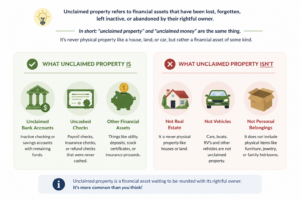
Here’s how the process typically works: A business, bank, insurance company, employer, or other organization loses contact with the rightful owner of a financial asset. After attempting to locate the owner for a period of time, the holder is generally required by law to turn the funds over to Florida’s Division of Unclaimed Property, where they remain until the owner or their heirs submit a valid claim.
The most common types of unclaimed property in Florida are:
- Inactive bank accounts
- Unclaimed insurance payouts
- Stocks
- Dividends
- Uncashed checks
- Deposits
- Credit balances
- Refunds
- Abandoned safe deposit boxes in financial companies
Did You Receive a Letter About Unclaimed Property?
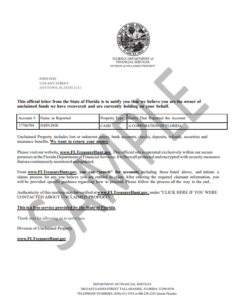
While the Florida Department of Financial Services will never text you, they will sometimes reach out to you by sending a letter to let you know you have unclaimed property. If the letter looks like the one below, it is legitimate.
How to Find and Claim Unclaimed Money in Florida
Searching for unclaimed money in Florida is fairly straightforward. If you locate property and decide to file a claim, it’s helpful to have the following items available, as they are commonly requested during the verification process:
- A copy of your driver’s license or some other type of state or government ID.
- Your social security number
- A physical document to provide proof of residency for the address associated with the claim
- Access to a printer and the ability to mail supporting documentation, if requested.
Keep in mind you don’t need any of these things to simply search and see if you have Florida unclaimed money to begin with. However, if you do find unclaimed money and want to see the process through to the end, you’ll need the materials listed above.
Step 1: Visit the Official Florida Unclaimed Property Website
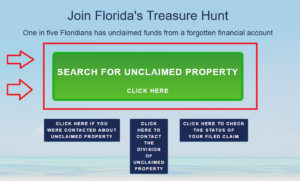
Go to https://www.fltreasurehunt.gov/ and click on the giant green box that says “SEARCH FOR UNCLAIMED PROPERTY”
Step 2: Choose Your Relationship Type
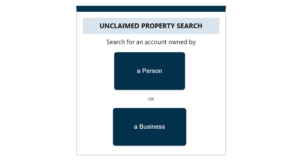
Click the appropriate box that applies to you. Most people are going to choose the “a person” box, but if you’re a business owner or former business owner you can click the second box to determine if you’re owed funds through your business.
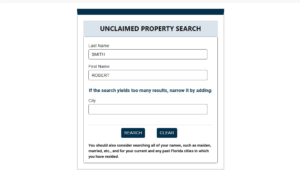
Step 3: Enter Your Name or Business Information
Enter your last name and first name in the appropriate fields. You can also include your city in the third field to narrow down the results, but keep in mind if you’ve lived in various cities in Florida you might have various addresses associated with unclaimed property.
Quick Tip – Make sure to try more than one of your names when applicable. If you have a maiden name for example you should search for that too.
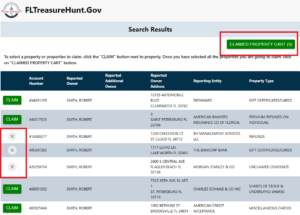
Step 4: Review the Search Results and Look For Your Name and Relevant Addresses
Search the results to see if your name and an address you associate with is among the results. If you find a match, click the green ‘claim’ button to add one or more properties to your cart, which will be displayed in the upper right hand corner. Once you’re satisfied with the claim(s), click that “claimed property cart” button to proceed.
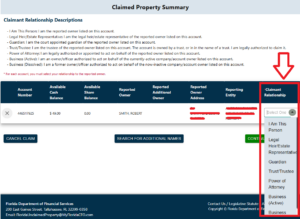
Step 5: Select Your Claimant Relationship (Again)
Use the dropdown menu under “Claimant Relationship” to choose the appropriate relationship. In most cases you will be selecting “I Am This Person” but there are various other relationships that can be chosen.
Check the descriptions at the top of the page if you’re unsure which option to select. Once you’ve selected the appropriate relationship, click the green ‘continue’ box to proceed.
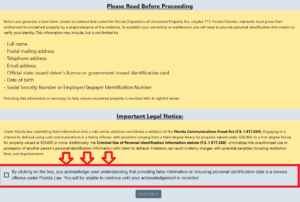
Step 6: Read the Claim Instructions Carefully
Carefully read the message on the next page about what documents you might need to provide. These documents may include any of the following:
- Full name
- Date of birth
- Postal mailing address
- Telephone number
- Email address
- Driver’s license or government-issued identification card
- Social Security Number or Employer/Taxpayer Identification Number
There is also a warning about the penalties associated with submitting false information in an attempt to defraud. It goes without saying, but do not under any circumstances try to claim property you don’t believe to be yours.
Once you’re ready to proceed, click the box at the bottom of the page, followed by the ‘Continue’ button.
Step 7: Enter Your Current Contact Information
Fill out the various forms with all your current information. You’ll need your social security number or tax ID number handy for this section. For the section where you provide your address, make sure it’s your current address you live at now, even if the address associated with your claim is different.
Once everything is filled out, click the green “SAVE CONTINUE” button at the bottom right hand corner.
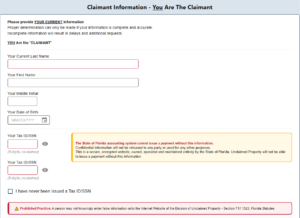
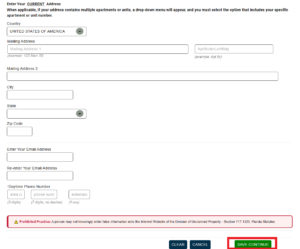
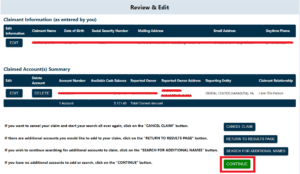
Step 8: Review and Submit Your Claim
On the “Review & Edit” page, verify that all your information looks good. If you’re ready to proceed, click the green “CONTINUE” button in the bottom right hand corner.
This will take you to a very similar page that says “Final Review Page” at the top. Verify your information once again, and then click the green “SAVE CONTINUE” button.
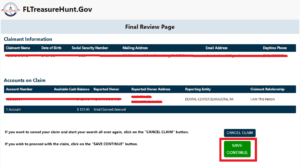
Step 9: Note Your Claim Number and Look For An Email From The State
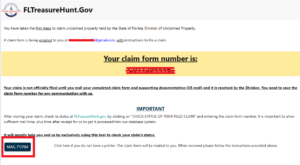
After a few seconds of waiting you’ll be taken to this page that gives you a claim form number. This completes the first steps in getting your unclaimed money returned to you, but please note the important language on the page:
“Your claim is not officially filed until you mail your completed claim form and supporting documentation (US mail) and it is received by the Division. You need to save the claim form number for any communication with us.”
Here’s what you should take away from this page:
- Your claim form will be emailed to the email address you provided. When I went through this process myself, the email showed up almost immediately after hitting “SAVE CONTINUE” on the “Final Review” page.
- You might need your claim form number again to check your claim’s status or ask any questions about your claim. It’s provided in the email they will send you along with the claim form, but it might not hurt to write it down from this page just in case.
- After receiving your claim form via email, you will be required to print the form, fill it out, and send the form as physical US mail. If you do not have access to a printer, the Florida Department of Financial Services will directly mail the form to your address. Simply click the “MAIL FORM” button and the form will be sent to you.
Step 10: Submit Any Required Documents
Assuming you are going to receive the form via email and print it out, look for an email from noreply@myfloridacfo.com. Your claim form should be attached as a PDF. The email looks like this:
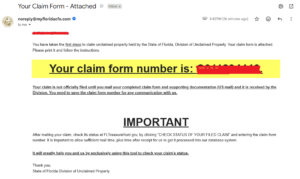
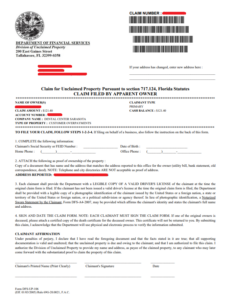
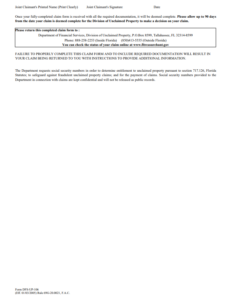
Print the two-page form attached in the email. It will already have information on it such as your name, address, claim number, and amount owed to you. If you chose the “MAIL FORM” option on the previous page, you should receive the form via physical mail. The two page form looks like this:
Step 11: Mail Your Filled Out Claim Form and Required Documents
This is the final step! All you need to do is:
- Fill out the relevant information in the first section
- Find a physical copy of a document that can provide proof of residency for the address associated with your claim (not your current address if it differs from the associated address). The document can be one of the following:
- Utility bill
- Bank statement
- Old correspondence
- Deed
- Create a legible copy of your VALID driver’s license using whatever method is easiest for you. Keep in mind the Department must be able to read the information on the copy, so make sure it looks good. *See the form for other types of ID they will accept in lieu of a driver’s license.*
- Sign the form and mail it, along with your proof of residency and copy of your ID, to the address provided.
How To Check The Status Of Your Unclaimed Money
Once you’ve gone through the process of mailing your claim forms and relevant documents to Florida’s Department of Financial Services, checking the status of your claim is super easy. Note that you’ll need your Claim Number in order to check your claim’s status, which you will receive after completing the digital of the process on the FLTreasureHunt website.
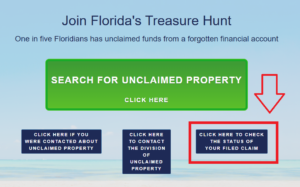
- From the FLTreasureHunt homepage, simply click the blue box that says “CLICK HERE TO CHECK THE STATUS OF YOUR FILED CLAIM”.
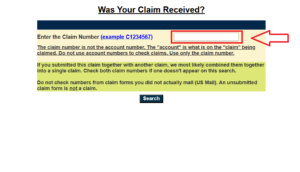
- Enter your claim number in the text box and click search.
Avoiding Scams and Common Mistakes
While the process for claiming unclaimed property in Florida is 100% legitimate, that doesn’t mean there aren’t scammers out there trying to take advantage of you. Be aware that the Florida Department of Financial Services will NEVER contact you by text message concerning unclaimed money or your specific claim. If you do receive a text message from someone claiming to be from the Department, be sure to avoid clicking any links and promptly delete the message.
Private Entities Who Collect Your Unclaimed Money For a Fee
One more thing to be aware of is that private entities will sometimes contact holders of unclaimed money soliciting the owners for assistance in filing for a fee. While this is legal under Florida law, be aware that unclaimed property is a FREE service provided by the Florida government. You are not required to pay a single cent to claim your property, but certain private investigators and CPAs are counting on you not knowing this.
Florida Unclaimed Property Auctions and Events
Sometimes unclaimed property auctions are held in Florida where you can bid on items that are considered unclaimed. The proceeds go directly to the owner’s account, where the money sits indefinitely until the owners or their heirs claim it.
The next Florida auction is being held Saturday, August 8th. Below are all the details:
When:
Friday, August 7th (Preview day only)
Saturday, August 8th (Auction day only)
Where:
Embassy Suites by Hilton
1601 Belvedere Road
West Palm Beach, FL 33406
561-689-6400
For more information on this auction, go to https://www.fltreasurehunt.gov/Auction.jsp
Helpful Resources
Below we’ve provided some resource links if you want to learn more about the Florida unclaimed property system.
Frequently Asked Questions About [State] Unclaimed Money
FAQ Question 1
FAQ Anwser 1 Lorem Ipsum yadayada
FAQ Question 2
FAQ Answer 1 Lorem Ipsum yadayada